What Is CAVA? A Wine Or A Restaurant
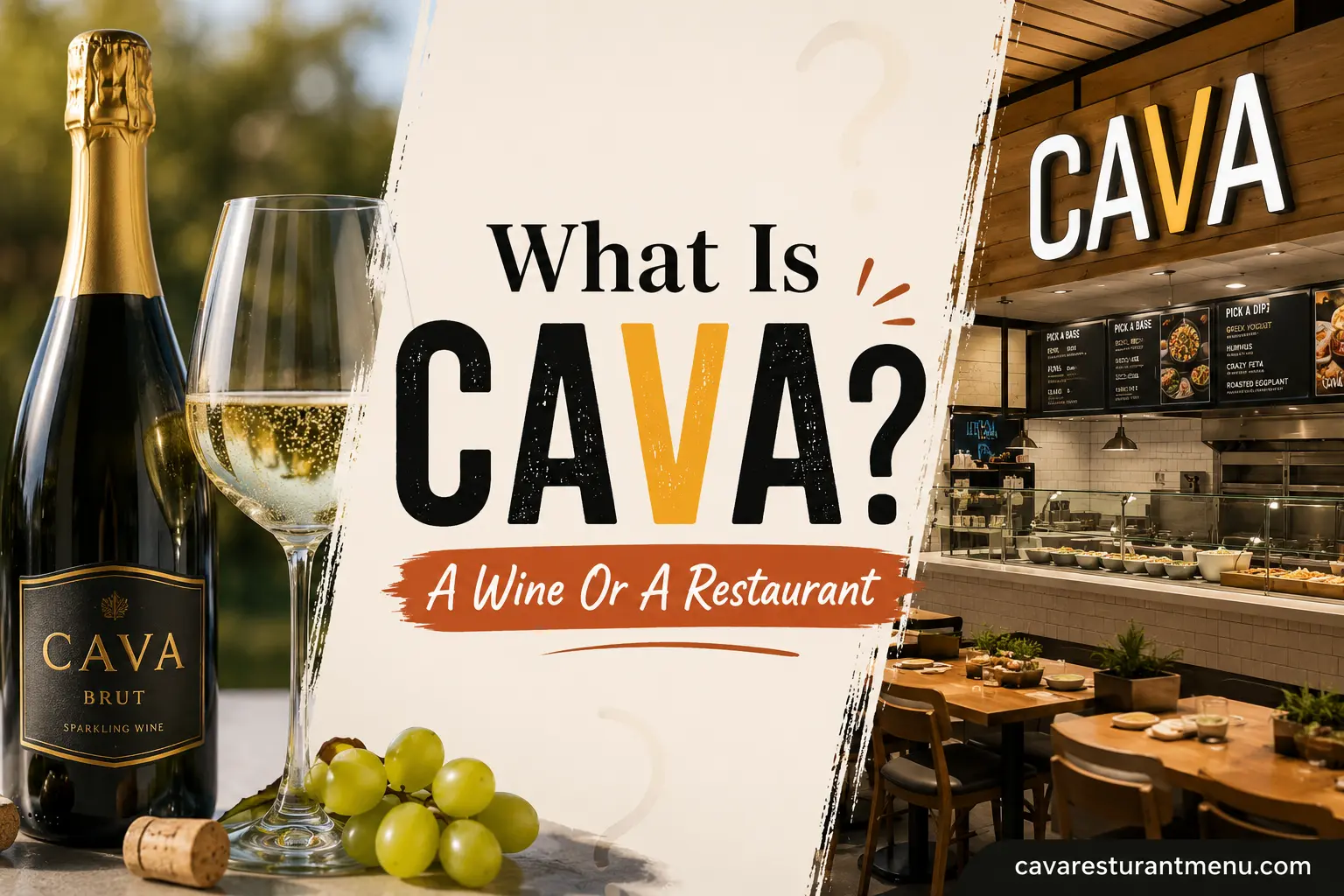
“Cava” means different things to different people. It is a fast-casual Mediterranean restaurant with 400+ US locations. It is Spain’s most famous sparkling wine. It is an ingredient in cocktails and sangria. And if you are searching for the Fijian ceremonial root drink, that is kava, a separate thing entirely, explained at the bottom of this page.
This guide covers every meaning, clearly and completely.
Jump to what you need:
What Is CAVA the Restaurant?
CAVA is an American fast-casual Mediterranean restaurant chain founded in 2006 by three first-generation Greek Americans — Ted Xenohristos, Ike Grigoropoulos, and Chef Dimitri Moshovitis — along with CEO Brett Schulman. The first location opened in Rockville, Maryland as a full-service restaurant called Cava Mezze. In 2011 they launched the fast-casual format in Bethesda, Maryland, and the chain has grown to over 400 company-owned locations across the United States as of 2026.
CAVA is publicly traded on the NYSE under the ticker symbol CAVA. It is the largest Mediterranean restaurant chain in the US. All locations are company-owned — CAVA does not franchise.
CAVA is known for its build-your-own bowl system, fresh daily-prepped ingredients, Mediterranean flavors, and one of the most customizable menus in fast-casual dining. It is widely considered a healthier alternative to traditional fast food.

CAVA Restaurant Key Facts
| Founded | 2006 (full-service); 2011 (fast-casual) |
| Headquarters | Washington, D.C. |
| Founders | Ted Xenohristos, Ike Grigoropoulos, Dimitri Moshovitis, Brett Schulman |
| Locations | 400+ across the United States (2026) |
| Stock ticker | NYSE: CAVA |
| Hours | 10:30 AM – 10:00 PM / 10:30 PM (varies by location) |
| Ordering | Dine-in, pickup, online, delivery (Uber Eats, DoorDash) |
| Franchised? | No — all locations are company-owned |
| Grocery products | Hummus, dips, and dressings sold at Whole Foods and other retailers |
| Birthday reward | Free entrée redeemable during birthday month via the CAVA app (CAVA Rewards members) |
What Does CAVA Serve?
CAVA’s menu is built around four formats:
Bowls
the most popular format. You choose a base, one protein, up to three dips and spreads, unlimited toppings, and a dressing. There are also 14 signature bowls with pre-set combinations for customers who prefer not to build from scratch.
Pitas
the same ingredients served inside a warm sprouted grain pita. The pita is made by Damascus Bakeries, a family-owned Brooklyn business founded in 1930, using seven freshly milled grains.
Salads
a greens-only base with protein, toppings, and dressing. The lightest format on the menu.
Sides and extras
hummus, pita bread, drinks, and family meal options available separately.
What Are CAVA’s Main Ingredients?
Bases
- Saffron basmati rice
- Brown basmati rice
- Black lentils
- RightRice
- Romaine
- Arugula
- Baby spinach
- Supergreens
- Splendid Greens
Proteins
- Harissa honey chicken
- Chicken shawarma
- Grilled chicken
- Spicy lamb meatballs
- Falafel
- Grilled steak
- Glazed salmon
Dips and spreads
- Hummus
- Tzatziki, a Greek yogurt dip
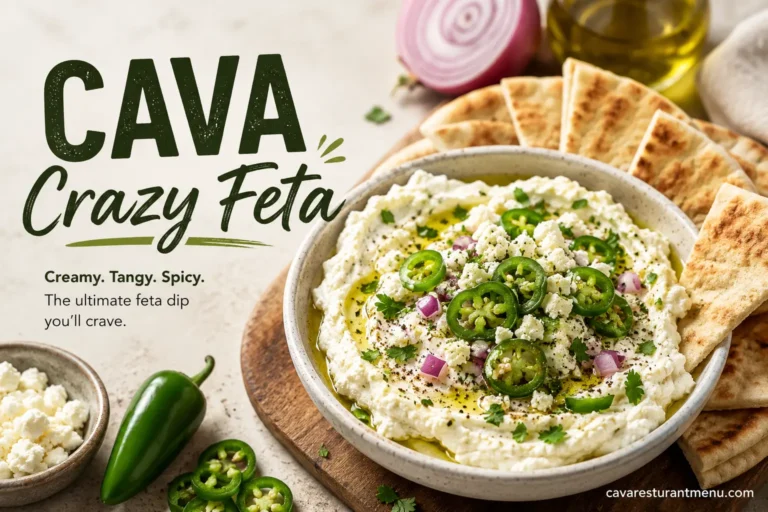
- Crazy Feta
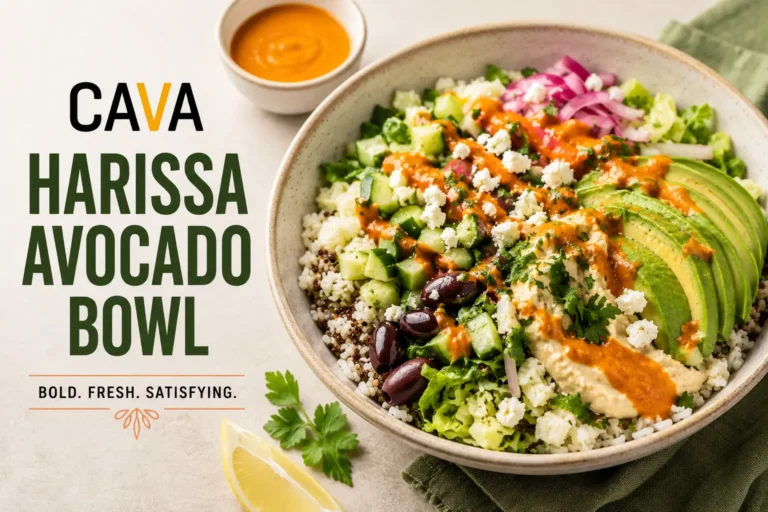
- Harissa
- Roasted red pepper hummus
- Eggplant and red pepper dip
Toppings
- Avocado
- Pickled onions
- Fire-roasted corn
- Crumbled feta
- Kalamata olives
- Tomato and cucumber salad
- Cabbage slaw
- Sumac slaw
- Banana peppers
- Pita crisps
- Lemon wedge
Dressings
- Lemon herb tahini
- Hot harissa vinaigrette
- Greek vinaigrette
- Skhug
- Garlic dressing
Is CAVA Healthy?
CAVA is widely considered one of the healthier fast-casual options available. Every protein is cooked fresh daily. Ingredients are whole — no processed filler, no artificial flavor bases. The menu accommodates a wide range of dietary needs including gluten-free, vegan, vegetarian, dairy-free, and high-protein builds.
CAVA does not serve alcohol at any of its restaurant locations.
A typical CAVA bowl ranges from roughly 400 calories (greens base, lean protein, light dressing) to over 1,000 calories (grain base, multiple dips, full toppings). The calorie count is entirely in the customer’s control.
How to Order at CAVA
In-store: You walk the counter line, choosing each component one at a time — base, protein, dips, toppings, dressing. The staff builds your bowl in front of you.
Online / app: Order ahead on the CAVA app and collect inside from a pickup shelf, skipping the counter line entirely.
CAVA Digital Drive-Thru (Pick Up By Car): At select locations, CAVA operates digital drive-thru pickup windows. You place your order through the app in advance and drive to a designated window to collect it.
CAVA Digital Kitchen: Some CAVA locations operate as digital-only kitchens with no dine-in seating, handling exclusively app-based pickup, delivery, and catering orders.
CAVA Table: At select dine-in locations, CAVA Table allows customers to order and pay from the table via the app, with food delivered to them rather than collected at the counter.
CAVA Rewards — Birthday Reward and Sun Status
CAVA’s loyalty program is called CAVA Rewards. Members earn points on every purchase, redeemable for free menu items. The program has tier levels, including a Sun Status tier for high-frequency customers, which unlock additional perks and early access to new menu items. Every CAVA Rewards member receives a free birthday reward redeemable as a free entrée or dip during their birthday month through the app.
What Is Cava the Spanish Sparkling Wine?
Cava is a Spanish sparkling wine with Denominación de Origen (DO) protected status. It is made using the same traditional method as French Champagne — second fermentation inside the bottle, but with Spanish grape varieties and at a significantly lower price point. The word “cava” means cave or cellar in Spanish, a reference to the underground cellars where the wine was originally stored and aged.
Cava is not the same as Champagne. It cannot legally be marketed as “Spanish Champagne” under EU law, as Champagne is a protected geographical designation belonging exclusively to the Champagne region of France.
Cava Wine — Key Facts
| Origin | Penedès, Catalonia, Spain (primarily) |
| Method | Traditional method — second fermentation in bottle |
| Main grapes | Macabeo, Parellada, Xarel·lo |
| Style range | Brut Nature (driest) to Dulce (sweetest) |
| Minimum aging | 9 months standard; up to 36+ months premium |
| Major producers | Codorníu, Freixenet, Gramona, Recaredo |
| Price range | $8–$15 entry level; $50+ premium Gran Reserva |
| Protected status | DO established 1986 |
| History | First produced 1872, Penedès, Catalonia |
Where Is Cava Wine Made?
Cava is produced primarily in the Penedès region of Catalonia, Spain, approximately 95% of all cava worldwide comes from here. The town of Sant Sadurní d’Anoia is known as the capital of cava and home to the two largest producers: Codorníu and Freixenet. Sparkling wine production in this region began in 1872 when winemaker Josep Raventós returned from a visit to France’s Champagne region and began producing bottle-fermented sparkling wine from native Spanish grapes.
Cava can also be produced in other Spanish regions including Valencia, Extremadura, Rioja, and Aragon, though these account for a small share of total production.
What Grapes Are Used in Cava?
The three traditional grape varieties are:
Macabeo — adds body and light floral aromatics with a lemony, slightly bitter finish.
Xarel·lo — the most aromatic; contributes structure, minerality, and pear and melon notes.
Parellada — adds delicate citrus character and smooths the acidity.
Chardonnay and Malvasia are also permitted in white cava. For rosé cava, permitted red grapes include Garnacha, Monastrell, Trepat, and Pinot Noir.
How Is Cava Wine Made?
Cava is made using the Traditional Method — the same technique used for Champagne. After an initial fermentation, yeast and sugar are added and the wine undergoes a second fermentation inside the sealed bottle. The carbon dioxide produced cannot escape, dissolving into the wine and creating the fine, persistent bubbles cava is known for. The wine then ages on its lees (dead yeast cells) inside the bottle — this aging is what builds flavor complexity.
Cava Wine Sweetness Levels
| Style | Sugar per litre | Taste |
|---|---|---|
| Brut Nature | 0–3g | Bone dry, sharp, mineral |
| Extra Brut | 0–6g | Very dry |
| Brut | Under 12g | Dry — the most common style; closest to standard non-vintage Champagne |
| Extra Seco | 12–17g | Off-dry |
| Seco | 17–32g | Semi-sweet |
| Semi Seco | 32–50g | Sweet |
| Dulce | 50g+ | Very sweet — dessert style |
Cava Brut is the most widely available style and the most Champagne-like in character — dry, crisp, and food-friendly. Most cava found in bars, restaurants, and shops will be Brut or Extra Brut.
Cava Wine Aging Categories
Cava must age a minimum of nine months. The longer the aging, the richer the wine.
Cava — minimum 9 months. Fresh, light, fruit-forward. Entry-level and most widely available.
Cava Reserva — minimum 15 months. More complexity, light bready and toasty notes.
Cava Gran Reserva — minimum 30 months. Rich, structured, with dried fruit, nuts, and brioche character.
Cava de Guarda Superior Paraje Calificado — minimum 36 months from a single certified vineyard. Rare and exceptional,comparable in quality to premium Champagne.
Cava vs Champagne vs Prosecco
Cava vs Champagne
both use bottle fermentation (Traditional Method), so the production is nearly identical. The differences are the grape varieties (Spanish vs French), the region, and the price. Cava is significantly more affordable while still offering the same production quality.
Cava vs Prosecco
Prosecco uses the tank method (Charmat method), producing larger, softer bubbles and a fresher, fruitier, slightly sweeter style. Cava is drier, more mineral, and more complex due to bottle aging.
What Does Cava Wine Taste Like?
Cava tastes lean, citrusy, and dry. Young cava is light and refreshing with green apple, lemon, and white flower notes. Aged cava develops baked and nutty character — almond, toasted brioche, and dried fruit. The fine, persistent bubbles and high acidity make it one of the most food-friendly sparkling wines available.
What Food Pairs with Cava Wine?
- Seafood — prawns, oysters, grilled fish
- Spanish tapas — jamón ibérico, croquetas, patatas bravas
- Soft cheeses and charcuterie
- Fried food — the acidity cuts through oil cleanly
- Light pasta and risotto
- Brut Nature and Extra Brut as an aperitif
- Semi Seco and Dulce with dessert
What Is Cava in Drinks and Cocktails?
Cava is a popular ingredient in cocktails, sangria, and mixed drinks, particularly in Spanish bars and restaurants. Its dry acidity and effervescence make it one of the most versatile mixing sparkling wines available, and its lower price point compared to Champagne makes it the practical choice for cocktail use.
Cava in sangria
white sangria made with cava is one of the most popular variations. The sparkling base keeps the drink lighter and more refreshing than still wine sangria. It is mixed with white wine, citrus fruit, a splash of brandy, and topped with cava just before serving to preserve the bubbles.
Cava in cocktails
cava substitutes directly for Champagne or Prosecco in any sparkling cocktail. Common uses include cava mimosas, cava bellinis (with peach purée), cava spritz (with Aperol or elderflower liqueur), and cava kir royale (with crème de cassis). Because cava is drier than Prosecco, it works better in cocktails where you want less sweetness.
Cava as an aperitif
Brut Nature and Extra Brut styles are served chilled as a standalone aperitif throughout Spain. Cava is the default celebratory drink in Catalonia the way Champagne is in France.
Serving temperature
cava should be served chilled, between 6°C and 8°C (43°F to 46°F). Place the bottle in an ice bucket for 20–30 minutes before serving. Do not store it in the freezer.
What Is Kava — The Fijian Root Drink?
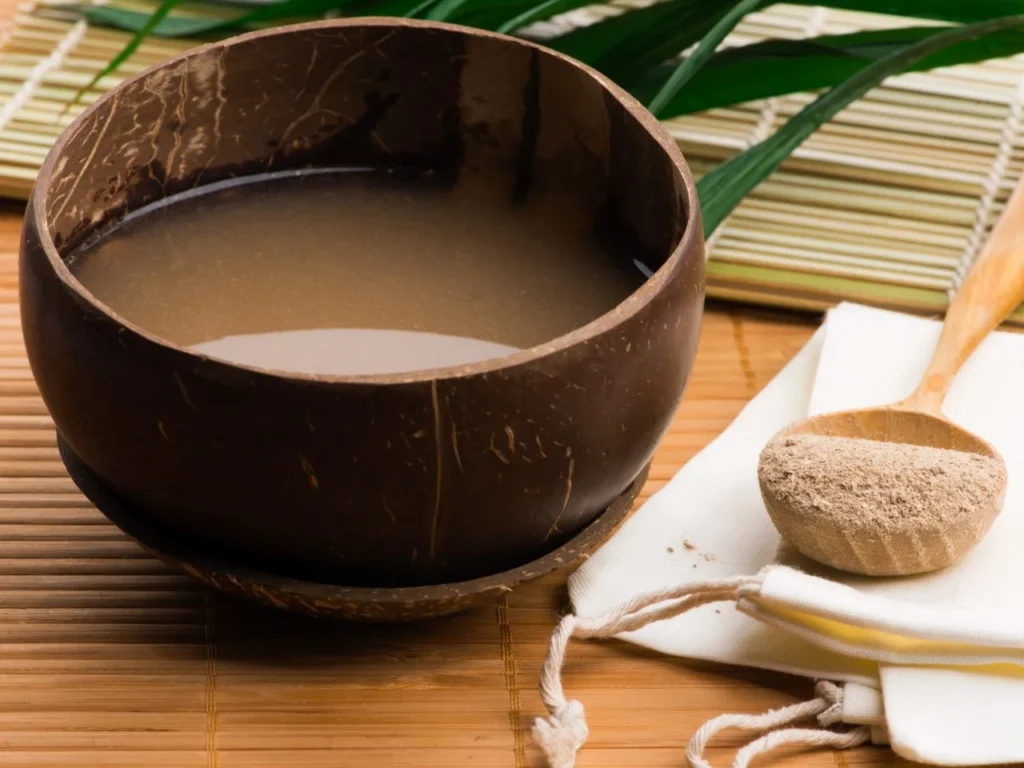
If you searched for “what is cava” but were looking for the Fijian ceremonial drink made from a plant root — that is kava, not cava. The two words are spelled differently but sound similar and are frequently confused in search.
Kava (Piper methysticum) is a plant native to the Pacific Islands, Fiji, Vanuatu, Tonga, and Hawaii. The root is ground into a powder, mixed with water, and consumed as a drink with mild sedative and anxiolytic effects. It has been used in Pacific Island cultures for centuries in ceremonial and social settings.
Kava is sold as a powder, in capsule form as a supplement, and at dedicated kava bars in the United States. It is non-alcoholic. It is unrelated to cava the Spanish sparkling wine and unrelated to CAVA the restaurant.
Quick Answer Summary to what is cava
| You searched for | What it is |
|---|---|
| CAVA restaurant | Mediterranean fast-casual chain, 400+ US locations, bowls/pitas/salads, NYSE: CAVA |
| Cava wine | Spanish sparkling wine from Catalonia, made like Champagne, dry and affordable |
| Cava in drinks | Used in sangria, mimosas, bellinis, spritz — a versatile cocktail sparkling wine |
| Cava Brut | The driest and most common cava style; closest to Champagne in character |
| Cava in Spain / Barcelona | The national sparkling wine of Catalonia; widely served at celebrations and bars |
| Kava / cava root / cava drug / cava Fiji | This is kava — a Fijian root drink, unrelated to cava wine or CAVA restaurant |